Why Your Next Smartphone Needs Micro-Cooling

The AI revolution is creating a thermal crisis at the computing edge.
For more than a decade, smartphones have been engineered around a little-discussed assumption: that the heat they generate can be managed passively. Which is to say, without fans. As mobile processors became more powerful, manufacturers responded with increasingly sophisticated ways of dissipating heat – graphite sheets, vapor chambers, and spreaders designed to distribute heat across the chassis, resulting in an overall cooler device.
This is because, of course, there’s been no place to put an actively powered cooling fan in a smartphone.
And for years, such passive solutions worked remarkably well. Even as chips from companies like Qualcomm and Apple grew more powerful, such cooling systems kept temperatures within acceptable bounds for most everyday tasks. Devices remained thin, silent, and sealed, with no need for fans or vents.
But as with many engineering solutions, the limits only became apparent when workloads changed. It’s not that passive cooling has stopped working; it’s that AI and other applications running on smartphones have dramatically altered the thermal picture.
The Supercomputer in Our Pocket
Modern smartphones are no longer bursty computing devices. They are increasingly asked to sustain performance over extended periods of time. People now carry supercomputers in their pockets, capable of editing 8K video, rendering console-quality games, and running complex generative AI models on-device. These workloads generate sustained heat.
Especially with AI now in the mix, smartphones have started to work overtime. For example, the processing demands of Apple devices have exploded by 56X in just six years. But thermal handling hasn’t kept pace.
In a passively cooled system, heat is not removed; it is redistributed. Eventually, the entire device approaches a thermal tipping point. Once that happens, there is nowhere for additional heat to go.
Many have experienced what comes next. Clock speeds drop. Frame rates dip. Processing slows. In some cases, brightness is reduced or features are temporarily limited. Qualcomm, for instance, specifies that when a device’s back cover exceeds 45°C, its Snapdragon 8 Gen 2 GPU drops its clock speed from 680 MHz to 300 MHz. Smartly, devices protect themselves through thermal throttling. But at the cost of user experience.
Granted, for now, the impact of heat in smartphones is not always dramatic, but it is cumulative and consequential. A few degrees of additional temperature at the system-on-chip level can trigger aggressive throttling. Zoom calls grow ineffective (“I’m just turning off my camera so I can hear you better.”) Sustained GPU loads become unstable or inconsistent. Battery efficiency declines as temperatures rise, reducing usable life between charges.
Manufacturers see the impacts coming better than anyone. Thermal constraints shape product design decisions long before a device reaches consumers. Engineers often limit peak performance to ensure acceptable thermals across a wide range of real-world conditions. Features are tuned conservatively to avoid overheating in warm environments or under direct sunlight.
And in a device as compact as a smartphone, there is little margin for error. Small inefficiencies quickly cascade into noticeable performance tradeoffs. That’s why smartphone makers are looking for thermal solutions that move air, not just spread it out.
A ‘Fan on a Chip’
As one might expect, active cooling is easier said than done. Conventional fans are fundamentally incompatible with smartphone design. They require space, introduce noise, consume power, and rely on mechanical components that can wear out over time.
Some niche gaming phones have experimented with miniature fans or external cooling attachments. These solutions demonstrate the value of airflow, but they are not practical for widespread adoption. The industry needs a different approach – one that delivers the benefits of active cooling without the drawbacks of traditional mechanical systems.
This is where micro-cooling (µCooling) enters the picture. Rather than attempting to move large volumes of air through a device, µCooling focuses on creating localized airflow at the chip level. The goal is not to replicate a laptop fan, but to provide enough directed airflow to prevent thermal saturation at critical hot spots.
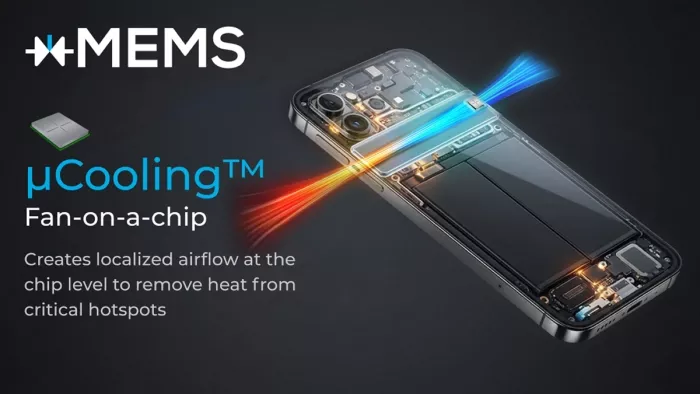
xMEMS has taken a distinctly semiconductor-centric path. Instead of miniaturizing traditional fans, it uses piezoMEMS technology to generate airflow through microscopic motion inside a silicon chip. Its solution is often described as a “fan on a chip.” Tiny silicon membranes vibrate at ultrasonic frequencies, producing pressure waves that move air across nearby surfaces, displacing air and generating directed convective airflow that pumps hot air out of the phone – a key capability no other solution has. All with no spinning blades and no conventional moving parts. It is, in effect, a solid-state air pump.
This architecture aligns closely with the constraints of smartphones. At roughly a millimeter thick, it can fit into tightly packed device designs without requiring major structural changes. Because it operates at ultrasonic frequencies, it is effectively silent. And because it is built using semiconductor manufacturing processes, it offers a pathway to the kind of scale and reliability that consumer electronics demand.
What makes this approach particularly compelling is not the volume of airflow it generates, but where and how that airflow is applied. In a thermally constrained environment like a smartphone, even modest airflow can have an outsized impact if it is directed precisely at the right location. By preventing heat from accumulating at the source, µCooling can delay the onset of throttling and maintain stable operating conditions for longer periods.
µCooling does not replace passive cooling. Heat spreaders and vapor chambers still play a role in distributing thermal energy. µCooling adds a missing layer: active heat removal at the points where passive systems struggle. Together, these approaches create a more balanced thermal system and ensure an optimal user experience.
The Key to Future Smartphones
The implications extend beyond incremental performance gains. As smartphones take on more demanding workloads – particularly in AI – the ability to sustain performance becomes as important as achieving peak performance. µCooling has the potential to extend gaming sessions without frame drops, enable more advanced on-device AI models to run continuously, and improve the reliability of high-resolution video capture.
It also gives device manufacturers greater flexibility. With improved thermal headroom, they can push performance boundaries without increasing device thickness or relying on conservative tuning. In an industry where form factor is tightly constrained, that flexibility is significant.
The evolution of smartphone cooling mirrors broader trends in computing. As performance increases, system-level constraints become more apparent. For years, passive cooling was sufficient because workloads were intermittent and manageable. Today, sustained performance demands have exposed its limits.
µCooling is not about replacing what already works. It’s about addressing what doesn’t exist. By introducing localized, solid-state airflow into the thermal stack, companies like xMEMS are targeting a bottleneck that has remained largely invisible – until now.
The smartphones of the future may look much like today’s devices on the outside. But internally, their ability to manage heat will increasingly define what they can do and how well they can do it.
Related Semiconductor IP
- SHA-256 Secure Hash Algorithm IP Core
- EdDSA Curve25519 signature generation engine
- DeWarp IP
- 6-bit, 12 GSPS Flash ADC - GlobalFoundries 22nm
- LunaNet AFS LDPC Encoder and Decoder IP Core
Related Blogs
- The Hidden Threat in Analog IC Migration: Why Electromigration rules can make or break your next tapeout
- What's it take to design DDR4 into your next SoC? Newly released DFI 3.0 Spec opens the flood gates for DDR4 design
- Could TSMC be your next chip design cloud owner?
- Will your next ASIC ever be an FPGA?
Latest Blogs
- Area, Pipelining, Integration: A Comparison of SHA-2 and SHA-3 for embedded Systems.
- Why Your Next Smartphone Needs Micro-Cooling
- Teaching AI Agents to Speak Hardware
- SOCAMM: Modernizing Data Center Memory with LPDDR6/5X
- Bridging the Gap: Why eFPGA Integration is a Managed Reality, Not a Schedule Risk